
Human vs AI photo editing for real estate: when to use which

AI photo editing has become a legitimate option for real estate photographers, not just something software companies talk about. Some tools process images in seconds, handle routine corrections across large batches, and cost far less than traditional editing services. But AI photo editing also has clear limits, and knowing where those limits sit saves you from delivering work that looks off.
Here is a practical breakdown of what AI handles well, where it falls short, and how to split your workflow between the two.
What AI photo editing actually does well
AI editing is genuinely useful for certain jobs, especially when you’re handling a large number of standard property photos.
For high-volume standard residential work, AI photo editing can move fast. Some platforms process a single image in around 10 seconds. Routine corrections like exposure balancing, basic color fixes, lens distortion, and noise reduction all fall comfortably within what AI handles consistently.
Sky replacements and basic day-to-dusk conversions work well on standard properties too, especially exteriors with clean edges and predictable lighting. Simple object removal, bins, parked cars, cables in open areas, tends to produce clean results when the scene is straightforward.
For photographers shooting 10 to 15 standard residential properties a week, AI can shave meaningful time off post-production on the simpler jobs.
>> See the full guide: How AI Is Transforming Real Estate Editing for Professional Photographers
Where AI photo editing falls short
This is where it gets more important to pay attention.
AI does not understand context. It cannot tell whether a window reflection is clutter worth removing or an architectural detail worth keeping. It does not know that the furniture placement looks wrong, or that the color on that brick wall is supposed to read warm, not neutral.

Properties that fall outside standard training data give AI tools trouble. Historic homes, unusual layouts, rooms with heavy mixed lighting, or properties with distinctive materials all tend to produce inconsistent results. Over-saturated colors, odd shadows, and unnatural textures show up more often than you would expect, and agents notice.
Virtual staging from AI is where the gap is most visible. AI-generated furniture often looks like it is floating above the floor or slightly disconnected from the room. Lighting on staged pieces rarely matches the actual light in the photo. For standard listings it might pass, but for anything premium, it does not hold up.
Complex object removal near curved edges, glass surfaces, or reflective materials also tends to leave artifacts that require manual cleanup anyway.
Edits where human editors still win
Some tasks consistently produce better results with human editors, regardless of how good AI tools get.
Luxury and high-end listings need emotional control that AI does not have. Over-editing kills the feel of a premium property fast, and human editors know when to stop.
Complex HDR blending with mixed lighting or tricky window situations needs someone who can read what the room actually looks like and make judgment calls. Same goes for sky replacements where the light direction between sky and property needs to match believably.
Virtual staging that needs to match a specific buyer demographic or a design brief requires creative decisions AI is not equipped to make. And galleries that need to feel consistent in style across 30 or 40 images, not just technically similar, benefit from a human who can hold that standard from first image to last.
How to split your workflow between AI and human editing
Most photographers do not need to pick one or the other. The split depends on what you are shooting.
Use AI photo editing for high-volume standard residential work, quick turnaround jobs, batch basic corrections, and straightforward exterior shots where the scenes are clean and predictable.
Use human editors for luxury listings, complex interiors, virtual staging, anything with difficult lighting or mixed sources, and any work where brand consistency or creative judgment matters.
Some photographers run AI as a first pass and send results to human editors for refinement. This hybrid approach can reduce turnaround without sacrificing quality on the harder edits.
AI vs human editing: quick comparison
| Task | AI photo editing | Human editing |
|---|---|---|
| Batch basic corrections | Fast and consistent | Slower, higher cost |
| Complex HDR blending | Inconsistent | Reliable |
| Simple object removal | Works well | Works well |
| Complex object removal | Leaves artifacts | Clean results |
| Virtual staging | Generic, often floating | Tailored to property |
| Luxury listings | Risk of over-processing | Better creative control |
| Style consistency across gallery | Limited | Strong |
| Revision flexibility | Minimal | Direct feedback loop |
What this means for outsourcing
Outsourcing to a human editing team is not the same as running an AI tool. Human editors handle what AI consistently misses, complex scenes, creative decisions, quality control across the full gallery, and a revision process that actually works.
For photographers building a reliable delivery workflow, a trusted editing partner covers the jobs where AI falls short while keeping turnaround fast on everything else.

At Imagtor, we handle real estate photo editing across HDR blending, object removal, virtual staging, and color correction. Every image goes through human review before delivery, not just automated processing.
FAQ
Can AI photo editing fully replace human editors for real estate?
Not yet, and probably not for anything above standard residential work. AI handles volume and routine corrections well, but misses context, creative judgment, and complex scenes.
Is AI photo editing good enough for luxury listings?
Generally no. The risk of over-processing and the lack of creative control make it a poor fit for premium properties where the feel of the image matters as much as the technical correction.
What works best for photographers handling high shoot volume?
Use AI for the straightforward standard jobs and human editors for anything complex, premium, or needing creative consistency. A hybrid approach gives you speed without sacrificing quality where it counts.
AI photo editing is a tool, not a replacement
AI photo editing works well for the right jobs. It handles volume, speeds up routine corrections, and keeps costs down on standard residential work. But it does not replace judgment, context, or the ability to hold a consistent creative standard across a full gallery.
Knowing which jobs suit AI and which ones need a human editor is how you keep turnaround fast without letting quality slip on the listings that matter most.
Spend less time editing and more time shooting. Imagtor helps real estate photographers deliver professional results with human photo editing, fast turnaround, and consistent quality across every job.
Start today with a FREE TRIAL and get a 10% BULK DISCOUNT on your first order.
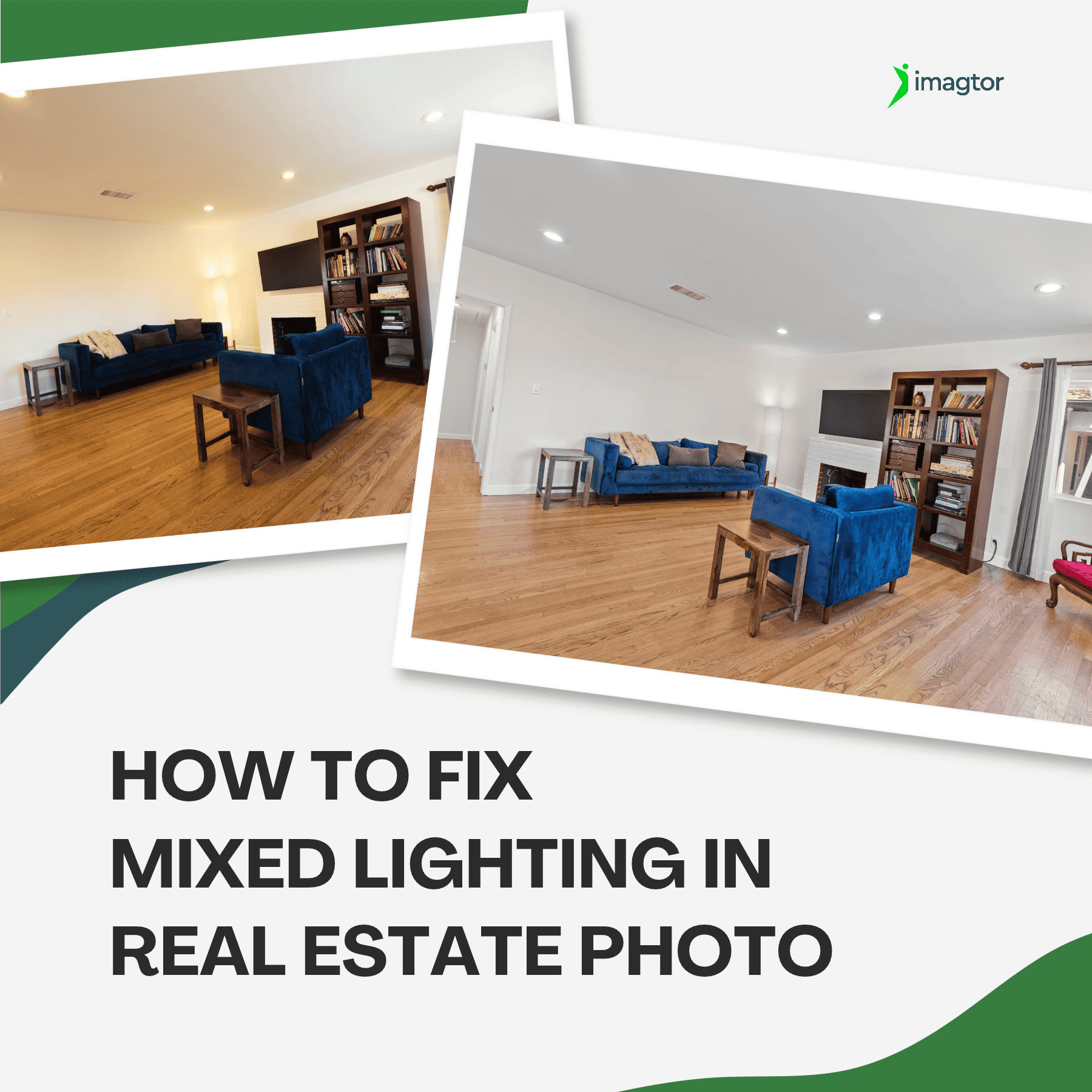
Color casts are one of the most frustrating problems in real estate interior photography. When daylight mixes with tungsten bulbs or LED strips in the same room, cameras try to average all those competing sources and the result is usually off. Walls look yellow, window views run too blue, and the gallery feels inconsistent. Knowing …

Real estate photo disclosure is no longer something photographers can ignore. California’s AB 723 took effect January 1, 2026, making it the first law in the US requiring agents and photographers to disclose when listing images have been digitally altered. More states are moving in the same direction, and the rules are changing how edited …